

Secure IT Disposal vs. Regular Recycling: The UK Business Case You Can’t Afford to Ignore
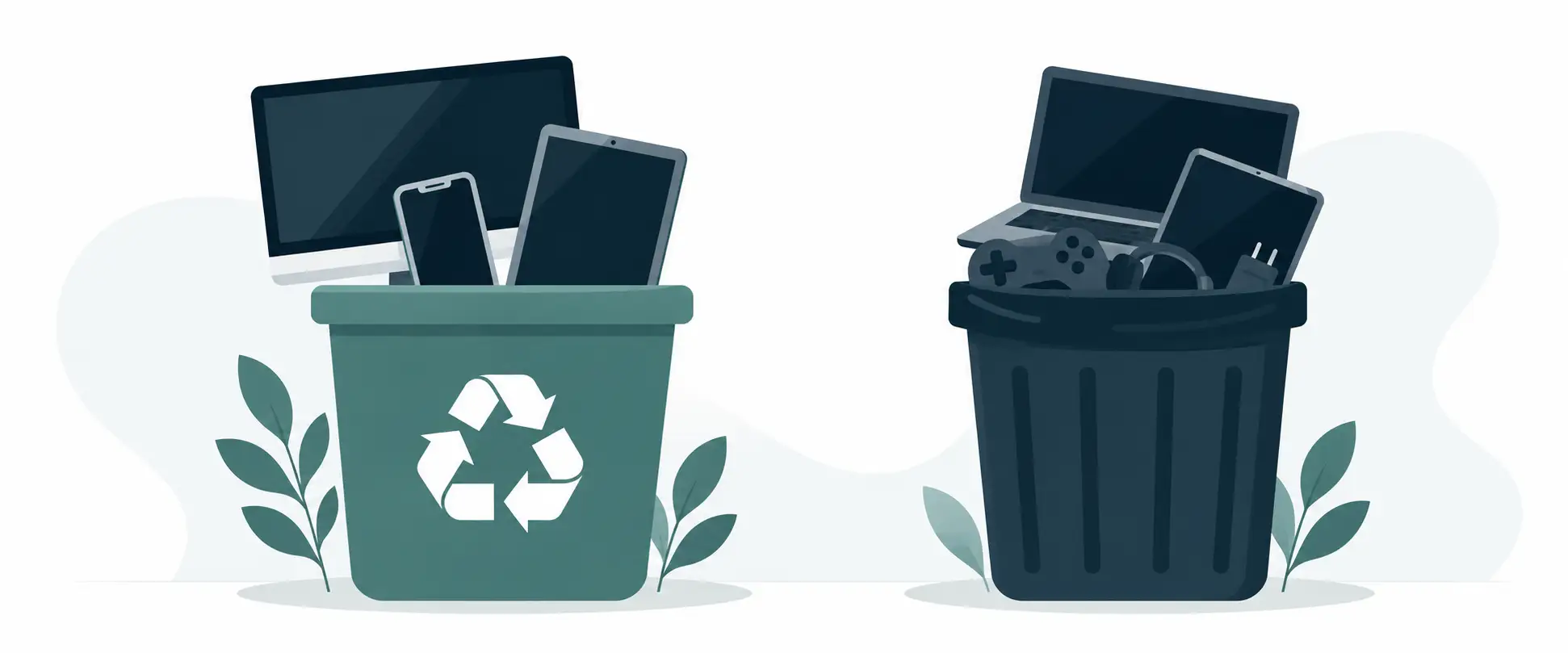
IT disposal has become a genuine priority for UK businesses — not just for sustainability, but because getting it wrong risks GDPR fines and data breaches. In that conversation, “IT recycling” and “secure IT disposal” get used as if they mean the same thing. They don’t, and the difference matters more than most businesses realise.
At a Glance
- Regular IT recycling recovers materials from retired equipment; it isn’t designed to address data security.
- Secure IT disposal adds controlled data destruction or sanitisation on top of that — the layer that actually protects your business.
- UK GDPR penalties for serious failures can reach £17.5 million or 4% of global annual turnover, whichever is greater.
- We handle both: certified data destruction to NIST 800-88, and WEEE-compliant recycling, with a certificate issued for every collection within 5 working days.
What Regular IT Recycling Actually Does
Regular IT recycling follows a fairly standard process: collection, sorting, materials recovery, and reuse. Equipment is collected, sorted into categories such as batteries, circuit boards and casings, processed to extract materials like gold, copper and plastics, and those materials go back into manufacturing new products.
It’s a genuinely valuable process environmentally — but its scope stops there. Materials recovery doesn’t involve checking what’s stored on a hard drive before it’s processed. If data security isn’t explicitly part of the service, it usually isn’t happening at all.
What Secure IT Disposal Adds
Secure IT disposal is recycling plus one more essential step: the controlled destruction or sanitisation of every data-bearing device before or during processing. That distinction matters because simple deletion or reformatting doesn’t remove data — it’s still recoverable with commonly available tools, which is exactly the gap regular recycling leaves open.
How Data Gets Properly Destroyed
Depending on the equipment and your policy, that means either software-based sanitisation — overwriting or cryptographic erasure — which keeps the hardware usable and resellable, or physical destruction such as shredding, which renders the device permanently unusable but gives the highest level of assurance for highly sensitive data. We cover exactly how these methods differ, and which to choose, in our guide to data wiping, sanitisation, degaussing and physical destruction.
The Hidden Cost of “Just Recycling”
If your equipment goes through materials recycling only, the environmental side is covered — the data-security side isn’t, and that gap has a cost. The realistic cost of “just recycling” is the combination of two things: the potential cost of a data breach, and the fines that follow non-compliance.
UK GDPR Exposure
UK GDPR is the UK’s post-Brexit equivalent of the EU’s GDPR, and it carries the same core principle: businesses are required to handle personal data lawfully and protect it throughout its lifecycle, including at disposal. Penalties for serious breaches can reach £17.5 million or 4% of global annual turnover — whichever is greater — and a general assurance that equipment was “recycled” isn’t evidence of compliance on its own.
How to Tell Which One You’re Actually Getting
The clearest way to check is to ask directly: does the service include certified data destruction, and will you receive a certificate naming specific serial numbers? If the answer is only about materials recovery, or the “certificate” is a generic statement rather than device-specific, you’re getting recycling, not secure disposal.
- Does the process include certified data destruction, not just materials recovery?
- Is a Data Destruction Certificate issued per device, naming serial numbers?
- Is the provider a registered waste carrier as well as a data destruction specialist?
Choosing Secure IT Disposal Over Recycling Alone
For most UK businesses, “just recycling” isn’t really a viable option once any device has held business or customer data — which, in practice, is almost every device. Secure IT disposal folds the environmental benefit of recycling together with the evidence a regulator, auditor or insurer would actually ask for.
We handle both in a single process: certified data destruction to NIST 800-88, WEEE-compliant recycling with 100% diverted from landfill, and a full compliance pack issued within 5 working days. Full certifications are available on our licenses page.
Booking Form
Free collection available for qualifying items · certificates within 5 working days · 100% diverted from landfill.