

Why WEEE Compliance Matters for Business Computer Disposal in the UK
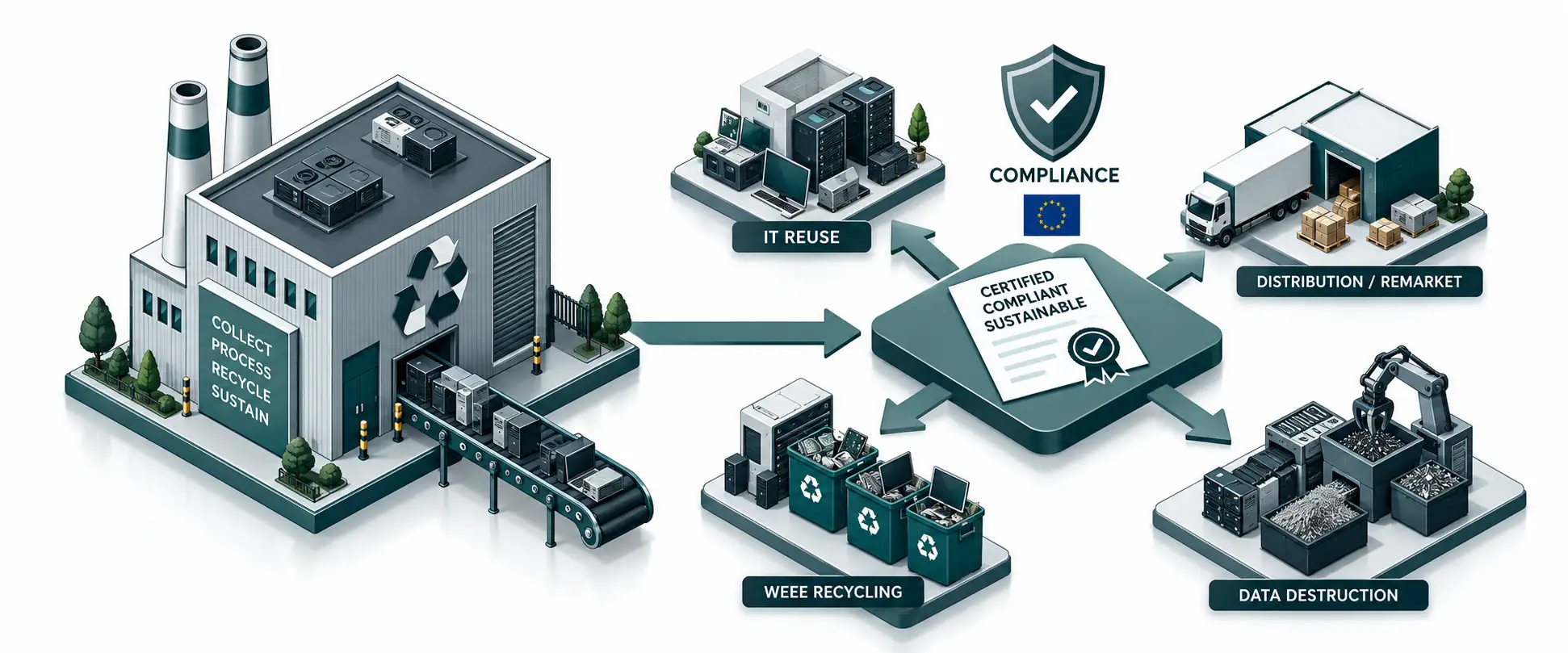
Tossing an old hard drive in a skip, or handing a laptop to whoever offers to take it away, can be one of the more expensive mistakes a business makes. A single forgotten drive can be the source of a data breach costing far more than the device was ever worth, and failing to destroy that data securely is a punishable offence in its own right. On top of that, WEEE Regulations can fine a business for the disposal itself, regardless of what was or wasn’t on the drive. This post covers why WEEE compliance has to sit alongside data destruction as a genuine priority for UK businesses, not an afterthought.
At a Glance
- WEEE Regulations require businesses to dispose of electronic equipment through a licensed route, with documentation to prove it — storage or good intentions don’t count as compliance.
- Fines for WEEE non-compliance can reach £5,000 per offence at magistrates’ court, and are unlimited at Crown Court for serious cases.
- UK GDPR requires secure data destruction for any device that’s held personal data, with penalties for serious breaches reaching £17.5 million or 4% of global turnover.
- We provide a serialised Data Destruction Certificate, WEEE Certificate and documented chain of custody for every collection, within 5 working days.
Real Enforcement, Not Hypothetical Risk
Both WEEE non-compliance and data protection failures have real, recent enforcement history behind them, not just a theoretical maximum penalty.
WEEE Enforcement
A UK mobile phone distributor was fined over £23,000 after being found guilty of breaching WEEE Regulations, including failing to register with a compliance scheme. A Northumberland-based recycling business and its director were separately fined more than £54,000 for failing to finance the collection, treatment and disposal of household WEEE items, as reported through the government’s own enforcement notices.
Data Protection Enforcement
Data protection enforcement can go much further. Amazon was fined €746 million by Luxembourg’s data protection authority in 2021 over how it used customer data for targeted advertising; Meta was fined €1.2 billion by Ireland’s Data Protection Commission in 2023; TikTok was fined €530 million in 2025. These were all enforced under EU GDPR by EU regulators — UK businesses answer to the ICO under UK GDPR specifically, which carries the same maximum penalty structure: up to £17.5 million or 4% of global annual turnover, whichever is greater.
What WEEE Actually Requires
WEEE stands for Waste Electrical and Electronic Equipment. The regulations exist to keep electronic waste out of landfill and incineration, both of which release harmful substances into the environment. The UK’s WEEE Regulations 2013 came into force in January 2014, implementing an EU directive that itself dates back to the early 2000s, and remain UK law after Brexit.
Who Has to Comply
Businesses that manufacture or sell electronic equipment under their own brand, resell equipment made by others under their own brand, or import electronic equipment, all fall under WEEE producer obligations. In practice, most businesses disposing of retired IT equipment also carry disposal obligations of their own, separate from producer responsibilities.
The Biggest Myth: Storage Isn’t Disposal
Storing old equipment in a warehouse is not the same as disposing of it, however long it’s been sitting there — WEEE compliance requires an actual, documented route to disposal, not just an intention to deal with it eventually. Donation doesn’t automatically satisfy this either: if you donate working equipment, you need documented proof that ownership, and disposal responsibility, has genuinely transferred to someone else.
What’s Actually at Stake
Non-compliance carries two distinct costs, and they compound each other.
Financial Penalties
WEEE fines can reach £5,000 per offence at magistrates’ court, and are unlimited at Crown Court for the most serious cases. Separately, a data breach traced to improperly disposed equipment brings UK GDPR exposure on top of that — two different regulators, two different sets of penalties, from a single mistake.
Loss of Trust
A single breach can undo years of customer and shareholder trust. If an old laptop or hard drive ends up somewhere it shouldn’t, and someone recovers the data on it, the fact that the device was “only being recycled” isn’t much comfort to the customers whose data was exposed. Working with a certified computer recycling partner that also guarantees data destruction closes that gap before it becomes a problem.
Key Obligations Under WEEE
Businesses with producer or distributor obligations under WEEE need to cover several things:
- Registration with the relevant national compliance scheme.
- Product labelling with the crossed-out wheelie bin symbol, to distinguish e-waste from general household waste.
- A free take-back system for customers returning old electronic products, where applicable.
- Reporting on the type and volume of electronics manufactured, distributed or sold.
- Proper collection, treatment and recycling of e-waste, in compliance with the regulations.
- Complete record-keeping across all of the above.
- Secure data destructionfor any device that held data.
An Executive-Level Checklist, Not Just an IT Task
WEEE compliance is a board-level risk, not something to delegate to IT and forget about. Here’s what should actually be in place:
A Genuine Data Destruction Certificate
A certificate worth having answers five specific questions: the date and time of destruction, the method used, the specific devices covered, detailed information on each device, and confirmation of what data was destroyed. A generic statement that devices were “processed” doesn’t meet that bar.
Asset Tracking and Chain of Custody
Your provider’s process should give you a detailed view of every device’s condition and location, with GPS-enabled logistics so equipment can be tracked in transit. A proper chain of custody means: barcode or RFID tracking of every device, timestamped logs at every hand-off, secure transport such as sealed, GPS-tracked containers, restricted-access facilities, and signed documentation at every transfer stage.
Zero Tolerance for Illegal Export
Some old computers end up illegally exported to countries with far weaker environmental protections when a business doesn’t ask the right questions of its provider. We cover exactly what to check for in our guide to spotting fake ‘certified’ IT disposal firms — due diligence here isn’t optional.
Shift From Reactive to Proactive
The strongest position is to build disposal into procurement and refresh cycles from day one, rather than treating it as a problem to solve once a storeroom is full. Refreshing equipment every 18 to 24 months, rather than waiting five years, keeps volumes manageable and reduces the amount of retired kit sitting around as a liability. A device-level audit roughly every two years — sorting what needs refurbishment, disposal or recycling — keeps that process honest rather than reactive.
Treat WEEE Compliance as a Business Risk, Not Back-Office Waste
Outdated or broken computers aren’t simply clutter to deal with eventually — handled wrong, they’re a genuine legal and financial risk, on top of the environmental one WEEE exists to prevent.
We provide certified WEEE-compliant recycling and data destruction for UK businesses, with full documentation and a compliance pack within 5 working days. Full certifications are available on our licenses page.
Booking Form
Free collection available for qualifying items · certificates within 5 working days · 100% diverted from landfill.