

IT Relocation and Decommissioning in London: How to Move or Clear Office IT Securely (2026 Guide)
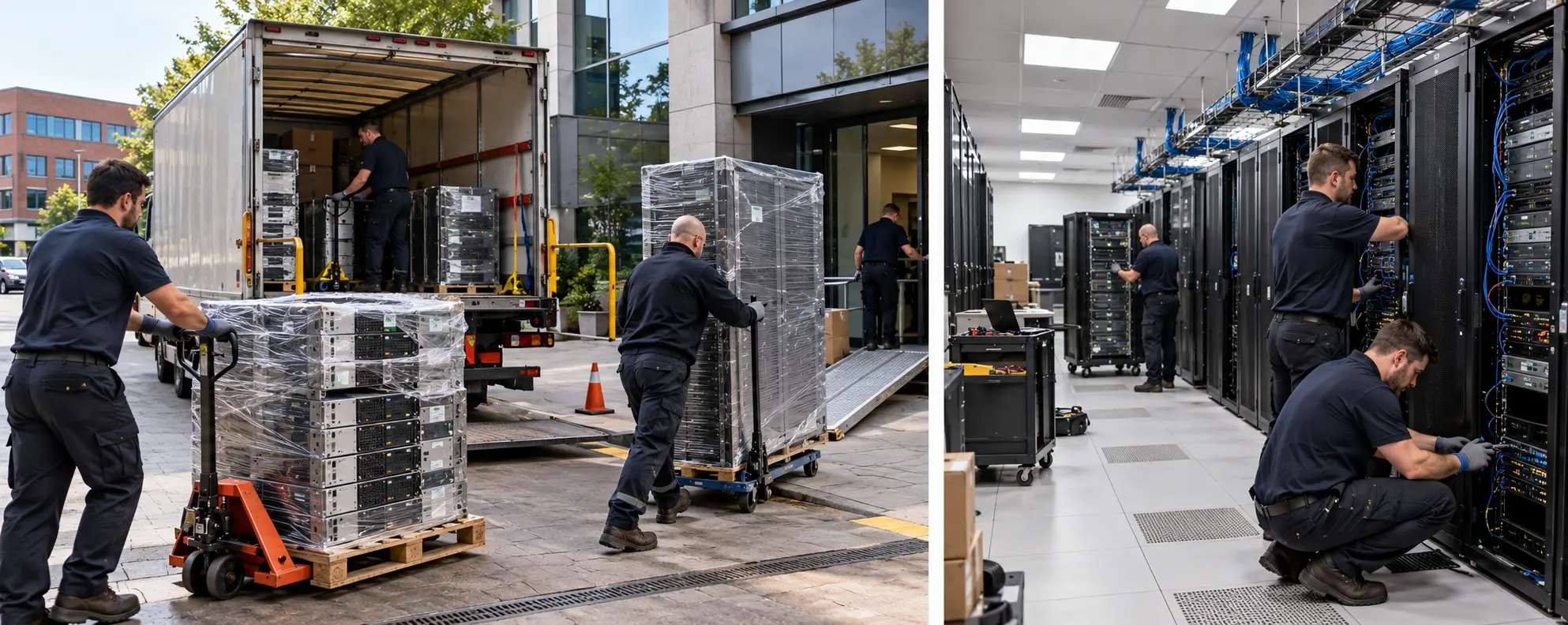
Quick answer: IT relocation is moving the equipment you keep to a new office. IT decommissioning is safely uninstalling, removing and disposing of what you don’t keep. Most London office moves need both. A secure project starts with a floor-by-floor inventory, removes or destroys data before anything leaves the building, packs and labels equipment by room, and ends with a certified audit of every serial number. Computer IT Disposals runs IT relocation and decommissioning projects across London, from single floors to multi-floor headquarters.
Key Facts
- Both in one project: equipment that is moving is packed, labelled and transported. Equipment that is not moving is wiped, resold or recycled.
- Data first: data-bearing devices are identified at the survey. Drives are erased to NIST SP 800-88 or HMG IS5, or shredded to BS EN 15713.
- Built for London buildings: lift-only buildings, dock bookings, multi-floor moves and out-of-hours working are routine.
- Own vetted staff: BS 7858:2019 security-screened teams and GPS-tracked, ULEZ-compliant vehicles. No subcontractors.
- Full audit trail: asset audit with serial numbers, data destruction certificates and WEEE certificate within 5 working days.
What Is IT Relocation and Decommissioning?
IT relocation means safely moving IT equipment that will stay in use: uninstalling it, packing and labelling it, and transporting it to the new office or to storage.
IT decommissioning means taking equipment out of service for good: uninstalling it, removing or destroying the data, and then reusing, reselling or recycling it.
In a typical London office move, newer laptops and AV may move, while old monitors, docks, comms-room switches and servers are retired. Handling both with one team means one inventory, one schedule and one set of paperwork.
What Equipment Is Included?
| Area | Typical equipment | Key consideration |
| Desks and open-plan floors | Monitors, docking stations, keyboards and mice, laptops, desktops | Volume: hundreds or thousands of items per floor |
| Meeting rooms and AV | Surface Hubs, video bars, displays, video walls, ceiling microphones, speakers, control panels | Systems packed and labelled together by room |
| Comms and server rooms | Switches, routers, firewalls, servers, storage, tape libraries, UPS | Configs, credentials and data must be removed |
| Print and office | Printers and multifunction devices | Many hold scanned documents on internal drives |
How an IT Relocation or Decommissioning Project Works
- Site survey and inventory. Every floor, room and comms cabinet is recorded: device type, quantity, location and serial numbers. The inventory marks what moves and what is retired.
- Plan and schedule. Work is phased floor by floor around lift and dock bookings, building access rules and your cutover date. Early, evening and weekend work avoids disruption.
- Data first. Data-bearing devices are identified before removal. For example, Surface Hub compute cartridges are removed and processed. Drives are erased with Blancco ADISA-certified software or shredded. On-site shredding is available where data must not leave the building (charges may apply).
- Uninstall, pack and label. Equipment is carefully uninstalled, wall-mounted displays included. AV systems are packed and labelled together by room, so they can be reinstalled or resold as complete systems.
- Secure transport. Our own vetted teams move equipment in locked cages and GPS-tracked vehicles to the new office, to storage, or to our Environment Agency licensed facility.
- Reuse, resale and recycling. Retired equipment is tested and graded. Working items are resold, and their value can offset project costs. Everything else is recycled. Nothing goes to landfill.
- You receive an asset audit with serial numbers, data destruction certificates, a WEEE certificate and an ESG report under one project reference.
Planning Checklist for a London Office Move
- Start the inventory early. Record equipment by floor, room and cabinet, with serial numbers where possible.
- Mark every item as move, retire or resell. This decides how each item is packed and processed.
- List all data-bearing devices, not just laptops: Surface Hubs, printers, servers, storage and network devices that hold configurations and credentials.
- Confirm building constraints: lift sizes, loading dock bookings, access hours and landlord rules.
- Agree your data policy: certified erasure for reuse, or shredding, on site or off site.
- Flag specialist equipment, such as video walls and boardroom AV, that must be packed and labelled as one system.
- Decommission comms rooms last, after the network has been cut over to the new site.
Case Study: Five-Floor Public-Sector Office in Central London
We recently completed a decommissioning project across a five-floor public-sector office in Central London, covering desk areas, meeting rooms, a boardroom and multiple comms rooms.
Read our five-floor public-sector office decommissioning case study to learn more about the project.
| Equipment | Quantity |
| Monitors | 1,750+ |
| Keyboard and mouse sets | About 980 |
| Docking stations | 208 |
| Surface Hubs | 48 |
| AV items (video wall, displays, video bars, mics, speakers) | About 250 |
| Comms rooms (switches, firewalls, servers, storage, UPS) | Multiple floors |
- Desk equipment removed floor by floor from inventories prepared by floor and area.
- AV equipment uninstalled, packed and labelled by room for resale, with boardroom systems kept together.
- Surface Hub data cartridges removed and data destroyed, with destruction certificates.
- Comms rooms cleared cabinet by cabinet, including redundant Cisco switching, firewalls, Dell and HP servers, storage and UPS units.
How Much Does IT Relocation or Decommissioning Cost?
Every project is quoted after a site survey, because cost depends on volumes, building access and timings. Collection is free for qualifying volumes, and the resale value of working equipment such as recent AV, docks and monitors can offset part of the cost. Any charges, such as on-site shredding, are agreed and approved by you before work starts.
IT Relocation and Decommissioning Across London
We work across every London postcode, from the City and Canary Wharf to Westminster, Holborn, King’s Cross and every Greater London borough. Our teams are experienced in lift-only buildings, dock bookings, government and corporate security procedures and live data centre environments. Retired equipment is handled through our IT asset disposal service.
About Computer IT Disposals
Computer IT Disposals is a UK IT asset disposal company, established in 2014 and based in Nottingham, working with businesses and public-sector organisations across London and the UK. We are ISO 9001:2015 and ISO 14001:2015 certified, Cyber Essentials Plus certified, ICO registered (ZA246798) and an Environment Agency Upper Tier Waste Carrier (CBDU457511). Company number 10675077. Full certificates are on our certifications page.
Related services: server recycling, monitor recycling, data destruction and public sector IT disposal.
Booking Form
Free collection available for qualifying items · certificates within 5 working days · 100% diverted from landfill.