
WEEE Compliance for Businesses: What UK Law Requires When You Dispose of IT
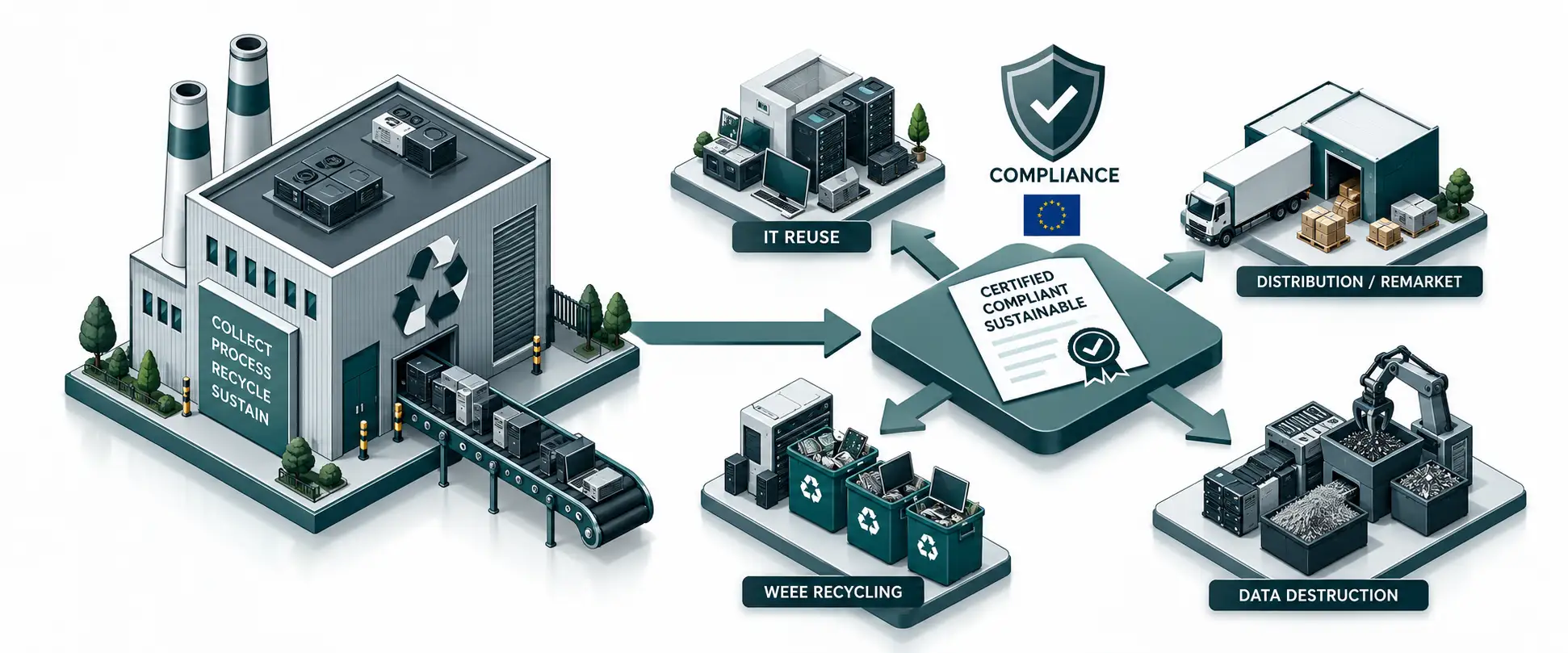
Quick answer: Old computers, laptops, screens and other IT are WEEE (waste electrical and electronic equipment), so a business can’t put them in general waste or a skip. You must store them safely, hand them only to a registered waste carrier, get a waste transfer note, and use hazardous waste paperwork for items such as CRT monitors and batteries. Data on the devices is a separate legal duty under UK GDPR. Breaching your waste duty of care is a criminal offence with unlimited fines.
Most businesses think of old IT as clutter. Legally, it is waste with two sets of rules attached: environmental law for the equipment and data protection law for what is stored on it. This guide covers what UK law requires, which obligations apply to you, and the paperwork that proves you met them.
What Counts as WEEE?
WEEE is any electrical or electronic item that has been thrown away, or is about to be. For a business, that usually means:
- desktops, laptops, servers, tablets and phones
- monitors, TVs and meeting-room screens
- printers, copiers and multifunction devices
- network equipment, UPS units, cables and peripherals
Some business WEEE is also hazardous waste, including CRT monitors (leaded glass), screens with fluorescent backlights and fluorescent tubes (mercury), batteries and UPS units, toner, and fridges or water coolers (refrigerant gases). Hazardous items need extra paperwork (see below). Worldwide, 62 million tonnes of e-waste were generated in 2022, and less than a quarter was documented as properly collected and recycled (Global E-waste Monitor 2024).
UK Waste Disposal Legislation That Applies to Business IT
| Law | What it means for you |
| WEEE Regulations 2013 | Electrical waste must be collected and treated separately, not landfilled. Most duties fall on producers and distributors (see below). |
| Environmental Protection Act 1990, section 34 (duty of care) | You must stop your waste causing harm or escaping, use only registered carriers, and complete a waste transfer note. |
| Hazardous Waste (England and Wales) Regulations 2005 | Hazardous WEEE moves under a consignment note. Scotland and Northern Ireland have equivalent rules. |
| Environmental Permitting (England and Wales) Regulations 2016 | Only permitted or exempt sites may store and treat WEEE. Your carrier should take it to one. |
| UK GDPR and Data Protection Act 2018 | Personal data on devices must stay secure until it is destroyed (Article 32). |
| Workplace Recycling Regulations (Wales, from April 2024) | Workplaces in Wales must separate small WEEE from other waste for collection. |
Your Duty of Care When Disposing of IT
- Store it safely. Keep retired equipment in a secure, dry area, with damaged batteries kept apart.
- Check your carrier. Search the Environment Agency public register of waste carriers before you hand anything over.
- Get a waste transfer note. Describe the waste and keep the note for at least 2 years (duty of care code of practice).
- Use consignment notes for hazardous items. Producers and holders must keep hazardous waste records for 3 years.
- Deal with the data. Have every data-bearing device erased or destroyed, and keep the certificate. See data destruction methods compared.
Producer, Distributor or End User: Which Rules Are Yours?
| You are… | If you… | Main WEEE obligations |
| Producer | make, rebrand or import electrical equipment, or sell it into the UK from abroad | Register with a compliance scheme, finance collection and recycling, mark products, report volumes |
| Distributor | sell electrical equipment to households | Offer take-back of old items, or join the Distributor Take-back Scheme |
| End user (most businesses) | buy and use IT, then dispose of it | Duty of care: safe storage, registered carrier, waste transfer notes, hazardous paperwork |
Check the details for your business in the GOV.UK WEEE guidance.
Storing Old IT Isn’t Disposing of It
Equipment in a storeroom is still your waste, and still your data risk. The longer it sits, the more likely drives go missing or batteries get damaged. Donating working equipment is fine, but keep a record that ownership passed to the recipient, and erase the data first.
What’s Changing: Digital Waste Tracking
From 1 October 2026, permitted sites in England and Wales that receive waste must record every load in the government’s digital waste tracking service (GOV.UK announcement). Scotland and Northern Ireland follow in 2027, and waste carriers are due to join in a later phase. For now, businesses that produce waste still need waste transfer notes and consignment notes as before. Ask your collector whether they are ready for digital tracking.
Penalties for Getting It Wrong
- Waste offences: breaching your duty of care is a criminal offence. Courts can impose unlimited fines.
- Data offences: the ICO can fine serious UK GDPR breaches up to £17.5 million or 4% of annual worldwide turnover, whichever is higher.
- Reputation: one recovered drive with customer data on it can cost more trust than any fine.
What a “Certified WEEE Recycler” Should Give You
“Certified” means little unless you can check it. A compliant recycler should give you:
- an upper tier waste carrier registration you can find on the public register
- collection to a permitted or exempt treatment site, with no export of untreated waste
- a waste transfer note, plus consignment notes for hazardous items
- a WEEE certificate confirming the equipment was treated and recycled
- a separate data destruction certificate listing each device by serial number
- tracked transport and a record of every hand-over
For warning signs, see how to spot fake “certified” IT disposal firms.
How Computer IT Disposals Handles Business WEEE
- Upper Tier Waste Carrier, Broker and Dealer (CBDU457511)
- mixed and hazardous WEEE collected in one visit, with consignment paperwork prepared for you
- every item counted onto a waste transfer note, signed digitally on site
- data-bearing devices erased or shredded and certified before recycling
- WEEE certificate, data destruction certificate, asset audit and ESG report within five working days
See our WEEE recycling service for businesses, monitor recycling, battery recycling and certificates and registrations.
Frequently Asked Questions
How long must we keep waste transfer notes?
At least 2 years. Hazardous waste consignment records must be kept for 3 years. Keep data destruction certificates for as long as your retention policy says, because they are your proof under UK GDPR.
Are we a WEEE producer if we only use IT equipment?
Usually not. Businesses that buy and use IT are end users, with duty of care obligations. You become a producer if you make, rebrand or import electrical equipment.
Are CRT monitors hazardous waste?
Yes. CRT monitors contain leaded glass, so they move under hazardous waste consignment paperwork rather than an ordinary waste transfer note.
Does a WEEE certificate prove our data was destroyed?
No. It proves the equipment was recycled. You need a separate data destruction certificate that lists each device by serial number.
Does digital waste tracking change what our business must do?
Not yet. From October 2026 the receiving sites record waste digitally. Businesses that produce waste still keep waste transfer notes and consignment notes, and later phases may extend the duty.
Talk to Us About Your Business WEEE
Computer IT Disposals is ISO 9001:2015 and ISO 14001:2015 certified, Cyber Essentials Plus certified, ICO registered (ZA246798) and an Upper Tier Waste Carrier, Broker and Dealer (CBDU457511), collecting across England, Scotland and Wales.
Get in touch: call 0333 015 3501 or email info@computeritdisposals.co.uk (Mon–Fri, 9:00–5:00), or contact us with a list of what you need collected.