
E-Waste Problems and Solutions: The Facts, the Risks and What Businesses Can Do
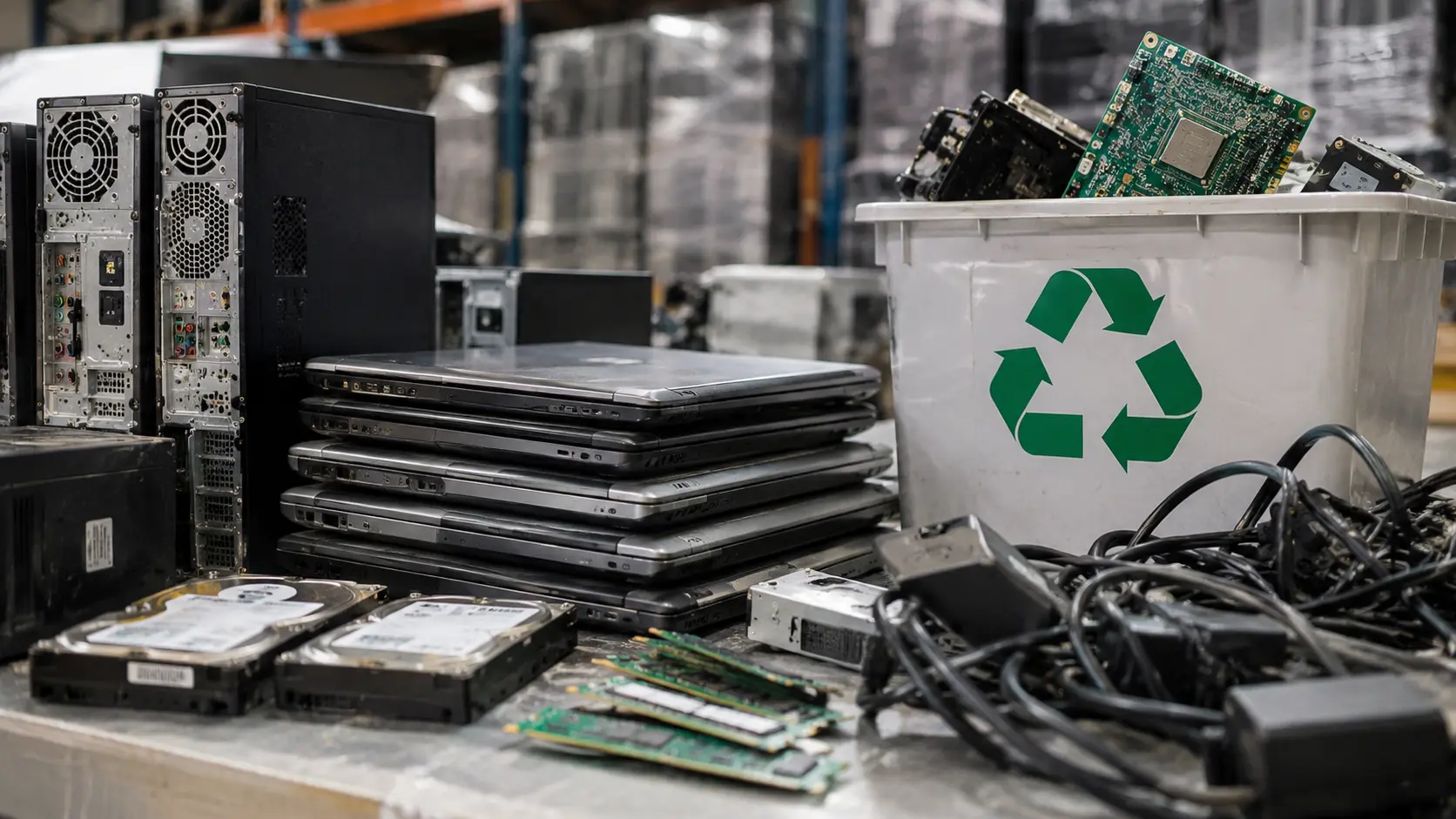
Quick answer: The world produced a record 62 million tonnes of e-waste in 2022, and only 22.3% was documented as properly collected and recycled. The main problems are toxic substances leaking into soil and water, valuable materials being lost, and data left on discarded devices. The solutions are to use equipment for longer, reuse and resell what still works, recycle the rest through registered collectors, and destroy data before anything leaves your control.
E-waste is the fastest-growing waste stream in the world, and businesses are a large part of it. Every laptop refresh, phone upgrade and office move adds to it. This guide sets out the key facts, the problems they cause, and the solutions that work for an organisation.
E-Waste Facts and Figures
| Fact | Figure | Source |
| E-waste generated worldwide (2022) | 62 million tonnes | Global E-waste Monitor 2024 |
| Documented as properly collected and recycled | 22.3% | Global E-waste Monitor 2024 |
| Annual growth | About 2.6 million tonnes a year | Global E-waste Monitor 2024 |
| Expected by 2030 | 82 million tonnes | Global E-waste Monitor 2024 |
| Value of metals in 2022 e-waste | US$91 billion (including $19bn copper, $15bn gold) | Global E-waste Monitor 2024 |
| Generated per person in Europe | 17.6 kg (7.5 kg documented as recycled) | Global E-waste Monitor 2024 |
| Small IT and telecoms equipment | 4.6 million tonnes, 22% documented as recycled | Global E-waste Monitor 2024 |
| UK e-waste per person | 23.9 kg: second-highest in the world, after Norway | Analysis of Global E-waste Monitor 2020 data |
Sources: UNITAR, Global E-waste Monitor 2024; Circular Online for the UK per-person figure.
The Main Problems With E-Waste
1. Pollution
Electronics contain lead, mercury, cadmium and brominated flame retardants. When e-waste is landfilled, burned or broken up informally, these substances can enter soil, water and air. For more on the wider impact, see the negative impacts of technology on the environment.
2. Lost Resources
Most of the gold, copper and other metals in discarded electronics are never recovered, so they have to be mined again. E-waste recycling meets no more than 1% of demand for essential rare earth elements.
3. Health Risks
People who handle e-waste without protection, often in countries that receive illegal exports, are exposed to toxic substances. Mercury, for example, can damage the brain and nervous system.
4. Data Security
This problem matters most to businesses. A discarded laptop or phone still holds emails, customer records and passwords until its storage is properly erased or destroyed. See data destruction methods compared.
Solutions: What Businesses Can Do
Use Equipment for Longer
Extending a laptop refresh cycle by a year, and repairing before replacing, cuts e-waste at the source. Buying refurbished equipment does the same.
Reuse and Resell What Still Works
Working equipment can be wiped and redeployed internally, donated, or remarketed through an IT asset disposal (ITAD) provider, often with a rebate. See ITAD vs IT recycling.
Recycle Everything Else Properly
Use a registered waste carrier that takes equipment to a permitted treatment site, and get a waste transfer note and a WEEE certificate. The practical steps are in how to dispose of electronic waste safely.
Destroy the Data First
Every data-bearing device should be erased or shredded, with a certificate listing it by serial number, before or during recycling.
Know Your Legal Duties
In the UK, electrical waste must be collected separately under the WEEE Regulations, and businesses have a duty of care for their waste. See our guide to WEEE regulations for businesses.
Measure It
Track what you dispose of and where it goes. An e-waste audit gives you data for ESG reporting and shows where to cut waste.
The Bigger Picture: Producers and Policy
Under producer responsibility rules, companies that make or import electronics pay towards collecting and recycling them. Better product design, such as repairable devices, replaceable batteries and fewer mixed materials, makes recycling easier. Because the global documented recycling rate is expected to fall to 20% by 2030, producers, recyclers and users all have a part to play.
How Computer IT Disposals Helps
- working equipment refurbished and remarketed, so it is reused rather than recycled
- everything else recycled under the WEEE Regulations, with 100% diverted from landfill
- every data-bearing device erased or shredded and certified
- an ESG report showing what was reused, recycled and diverted, for your sustainability reporting
See our WEEE recycling service and IT asset disposal.
Frequently Asked Questions
What are the main problems caused by e-waste?
Pollution from toxic substances, loss of valuable materials that are never recovered, health risks for people handling it unsafely, and data left on discarded devices.
How much e-waste does the UK produce?
An analysis of Global E-waste Monitor data put the UK at 23.9 kg per person, the second-highest in the world after Norway.
What is the best solution to e-waste?
Producing less of it: use devices for longer, then reuse or resell what still works. Recycling through a registered collector is the right route for what is left.
How much e-waste is recycled?
Worldwide, 22.3% of e-waste was documented as properly collected and recycled in 2022, and that share is expected to fall to 20% by 2030 as e-waste grows faster than recycling.
Why is e-waste a data security problem?
Devices keep their data after they are thrown away. Unless storage is erased or destroyed with proof, anyone who recovers the device may be able to read it.
Talk to Us About Reducing Your E-Waste
Computer IT Disposals is ISO 9001:2015 and ISO 14001:2015 certified, Cyber Essentials Plus certified, ICO registered (ZA246798) and an Upper Tier Waste Carrier, Broker and Dealer (CBDU457511), collecting across England, Scotland and Wales.
Get in touch: call 0333 015 3501 or email info@computeritdisposals.co.uk (Mon–Fri, 9:00–5:00), or contact us.